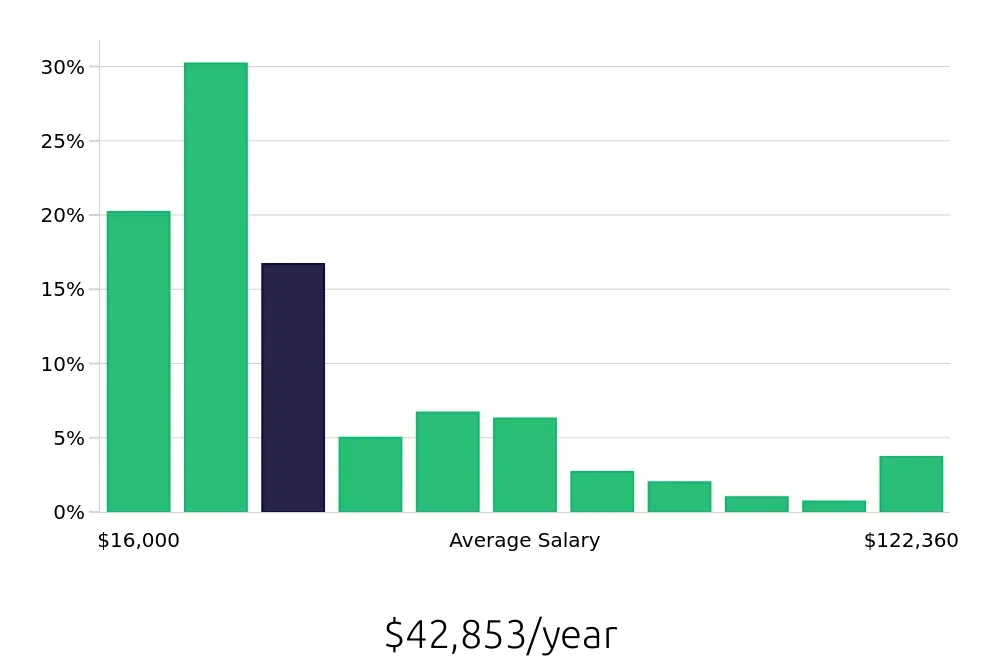
The average salary in Long Beach, MS is $42,853 per year.
Job seekers in Long Beach, MS, can find diverse opportunities with competitive salaries. On average, the yearly salary stands at $42,853. This figure includes a range of positions across different sectors. This diverse salary distribution reflects a vibrant job market offering various income levels.
Here is how the salary distribution breaks down: 20.17% of jobs offer a salary of $16,000 or below. About 30.17% of positions pay between $16,000 and $25,669. Another 16.67% of roles fall within the range of $25,669 to $35,338. A smaller percentage, 5.00%, pay between $35,338 and $45,007. Only 6.67% of jobs offer salaries from $45,007 to $54,676. Even fewer, 6.33%, pay between $54,676 and $64,345. Just 2.67% of positions offer salaries ranging from $64,345 to $74,014. Another 2.00% of roles fall between $74,014 and $83,683. The top earners, 1.00%, earn $93,352 and above. Lastly, 0.67% of jobs offer salaries of $103,021 or higher. This distribution highlights the variety in salary levels available to job seekers in Long Beach, MS.