How much does a Quantitative Analyst make?
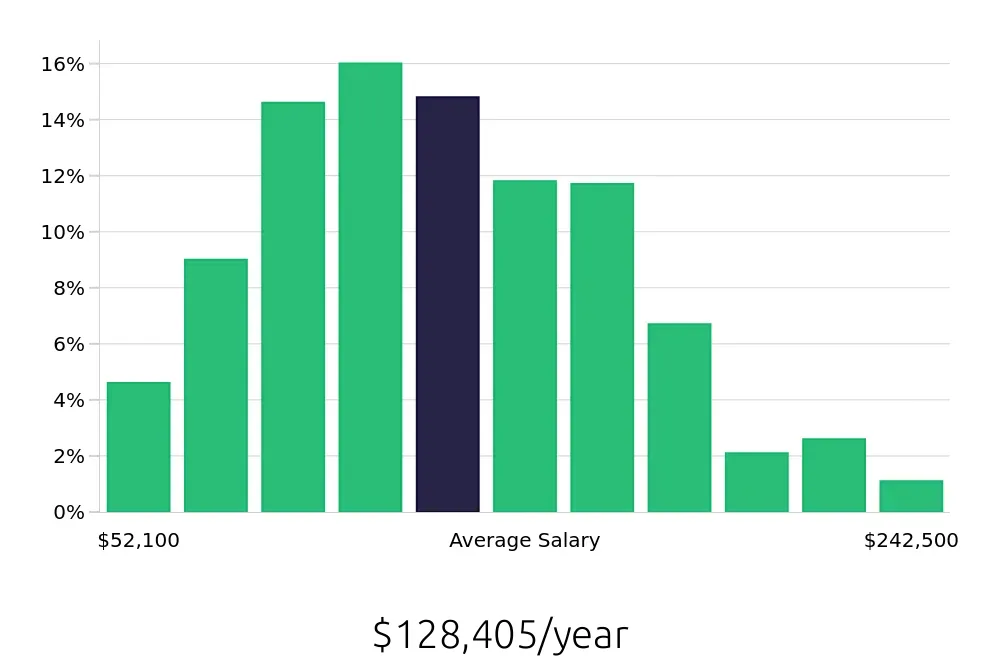
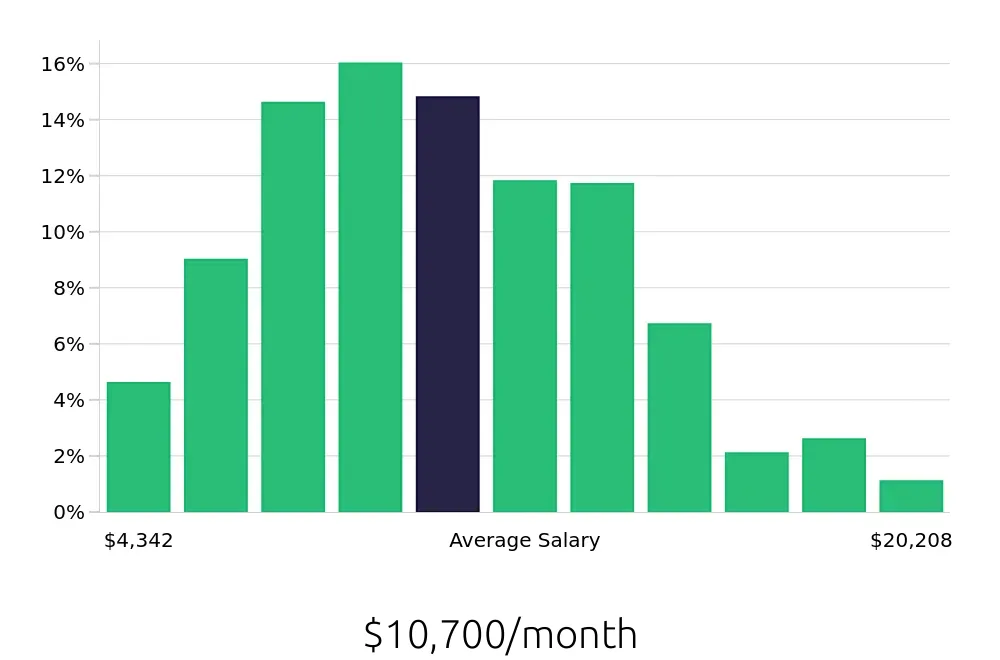
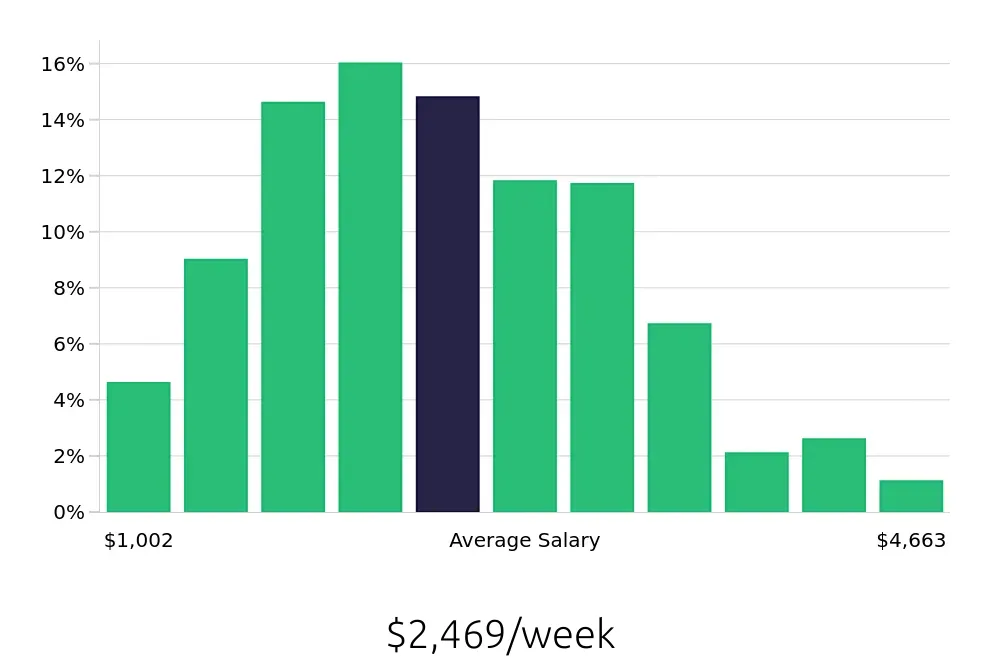
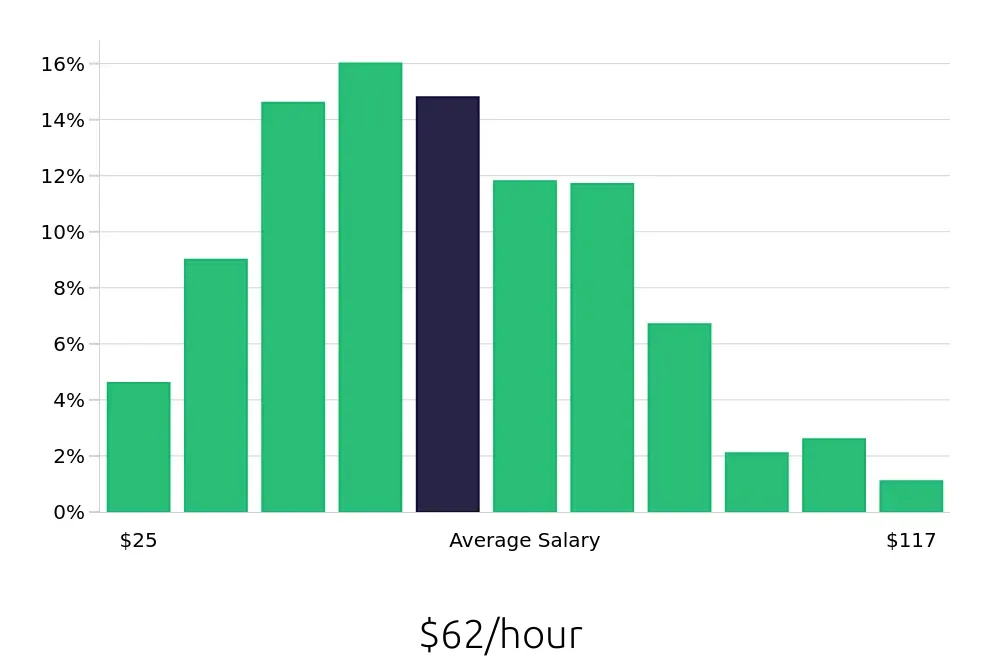
Quantitative Analysts, often called "quants," use math and data to help companies make smart decisions. They can work in many fields, including finance, healthcare, and tech. The salary for a Quantitative Analyst depends on experience and the industry. On average, a Quantitative Analyst makes around $128,405 a year.
Here are some salary ranges based on different experience levels:
- The bottom 10% earn less than $52,100.
- The next 10% earn between $52,100 and $69,409.
- The next 15% earn between $69,409 and $86,718.
- The next 16% earn between $86,718 and $104,027.
- The next 15% earn between $104,027 and $121,337.
- The next 11% earn between $121,337 and $138,646.
- The next 11% earn between $138,646 and $155,955.
- The next 6% earn between $155,955 and $173,264.
- The next 2% earn between $173,264 and $190,573.
- The next 2% earn between $190,573 and $207,882.
- The top 2% earn more than $207,882.
What are the highest paying cities for a Quantitative Analyst?

-
San Francisco, CA
Average Salary: $160,233
In San Francisco, professionals often find themselves at the forefront of finance and tech. They work in a dynamic environment with leaders like Goldman Sachs and JPMorgan Chase. The city's vibrant tech scene offers numerous opportunities for growth.
Find Quantitative Analyst jobs in San Francisco, CA
-
Boston, MA
Average Salary: $139,788
Boston offers a mix of traditional finance and innovation. With firms such as Fidelity and State Street, you will engage in strategic financial analysis. The city's academic institutions also provide rich networking opportunities.
Find Quantitative Analyst jobs in Boston, MA
-
Washington, DC
Average Salary: $139,246
In Washington, DC, analysts work in a political and financial hub. Working for companies like BlackRock and Fannie Mae, they focus on risk management and policy analysis. The city's political climate adds unique insights to financial strategies.
Find Quantitative Analyst jobs in Washington, DC
-
Dallas, TX
Average Salary: $136,523
Dallas is a growing financial center with a strong energy sector. Analysts here work with companies like JPMorgan Chase and Bank of America. The city's warm climate and lower cost of living add to the appeal.
Find Quantitative Analyst jobs in Dallas, TX
-
Baltimore, MD
Average Salary: $135,087
Baltimore offers a mix of urban and suburban living. Analysts here work with companies like T. Rowe Price and Legg Mason. The city's vibrant arts scene provides a well-rounded professional experience.
Find Quantitative Analyst jobs in Baltimore, MD
-
San Antonio, TX
Average Salary: $132,830
In San Antonio, professionals enjoy a growing economy and a strong tech presence. Companies like Valero Energy and AT&T offer exciting opportunities. The city's rich culture and affordable living make it attractive to many.
Find Quantitative Analyst jobs in San Antonio, TX
-
Charlotte, NC
Average Salary: $132,293
Charlotte is a financial hub, home to major banks like Bank of America and Wells Fargo. Analysts here focus on complex financial models and risk management. The city's growing job market offers many opportunities for advancement.
Find Quantitative Analyst jobs in Charlotte, NC
-
Houston, TX
Average Salary: $131,801
Houston is a key energy and finance center. Professionals work with companies like Shell and Citigroup. The city's diverse economy and affordable living make it an attractive place to live and work.
Find Quantitative Analyst jobs in Houston, TX
-
Atlanta, GA
Average Salary: $127,569
Atlanta offers a mix of corporate and entrepreneurial opportunities. Companies like SunTrust and Coca-Cola provide various roles. The city's growing tech scene adds to the dynamic work environment.
Find Quantitative Analyst jobs in Atlanta, GA
-
Los Angeles, CA
Average Salary: $124,486
In Los Angeles, professionals benefit from a diverse and innovative job market. Companies like Capital Group and TPG Capital offer unique opportunities. The city's entertainment industry adds to the vibrant work culture.
Find Quantitative Analyst jobs in Los Angeles, CA
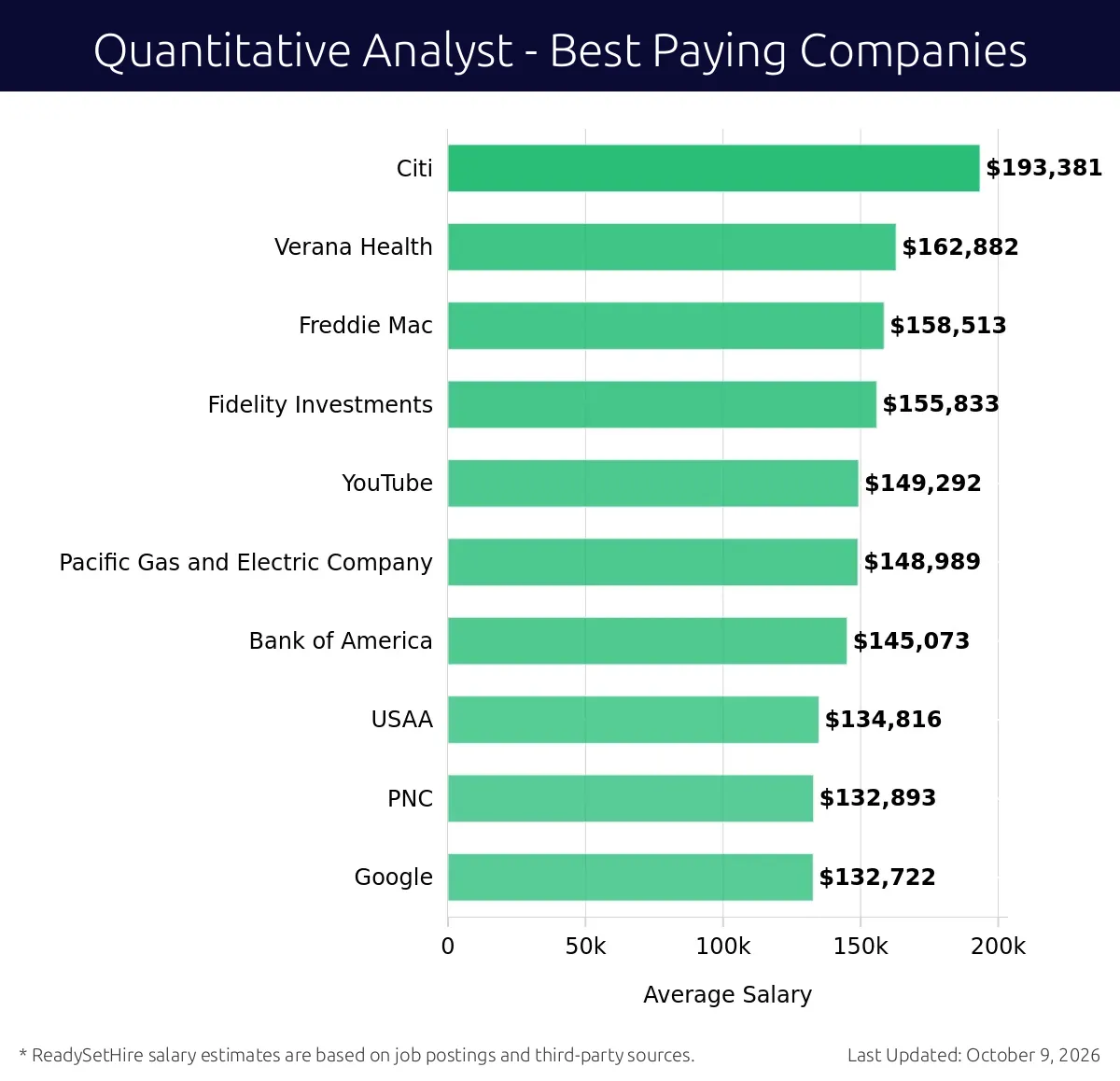
What are the best companies a Quantitative Analyst can work for?
-
Citi
Average Salary: $193,381
Citi is a global banking company that offers various Quantitative Analyst positions. These roles can be found in key financial hubs like New York, London, and Hong Kong. Citi’s Quantitative Analysts often work on risk management and modeling to support decision-making.
-
Verana Health
Average Salary: $162,882
Verana Health focuses on health data analytics and specializes in eye diseases. Quantitative Analysts here use data to drive insights and strategies. This company operates across the United States, with main offices in New York and Philadelphia.
-
Freddie Mac
Average Salary: $158,513
Freddie Mac, or the Federal Home Loan Mortgage Corporation, works to support homeownership. Quantitative Analysts in this organization develop models to assess risk and market trends. The company has offices across the U.S., including major cities like Washington, D.C., and San Francisco.
-
Fidelity Investments
Average Salary: $155,833
Fidelity Investments provides financial services to individuals and institutions. They offer many Quantitative Analyst roles focusing on investment modeling and analysis. With a presence in cities like Boston and Austin, Fidelity looks for talent who can help manage financial data effectively.
-
YouTube
Average Salary: $149,292
YouTube, a subsidiary of Google, provides video content and employs Quantitative Analysts to understand user behavior. These analysts work in San Bruno, California, to improve content recommendations and user engagement.
-
Pacific Gas and Electric Company
Average Salary: $148,989
PG&E is an energy company with Quantitative Analysts working on energy consumption and market trends. They operate in California, where offices are based in San Francisco and Roseville. Analysts here develop models to optimize energy distribution and pricing strategies.
-
Bank of America
Average Salary: $145,073
Bank of America offers diverse Quantitative Analyst roles focusing on risk management and financial modeling. With headquarters in Charlotte, North Carolina, and branches nationwide, these roles involve analyzing market trends and investment strategies.
-
USAA
Average Salary: $134,816
USAA provides financial services to military personnel and their families. Quantitative Analysts here focus on risk assessment and market analysis. The company is headquartered in San Antonio, Texas, and also has offices in San Francisco and Charlotte.
-
PNC
Average Salary: $132,893
PNC Bank offers banking and financial services. Quantitative Analysts at PNC focus on risk management and financial modeling. With offices in Pittsburgh and Indianapolis, these roles support decision-making processes for the bank.
-
Google
Average Salary: $132,722
Google employs Quantitative Analysts to work on data analysis and model development. They are located in major tech hubs like Mountain View, California, and New York City. Analysts here focus on improving search algorithms and user experience.
How to earn more as a Quantitative Analyst?
Quantitative Analysts can boost their earnings by focusing on key areas. Attention to detail, strong analytical skills, and a solid understanding of financial markets are crucial. An individual should also consider the following factors to enhance their professional growth and salary potential.
First, gaining experience in multiple financial markets can increase a Quantitative Analyst's value. Experience in both trading floors and risk management roles provides a well-rounded skill set. Second, obtaining relevant certifications like the Chartered Financial Analyst (CFA) designation can lead to higher pay. Third, developing expertise in programming languages like Python or R can set an analyst apart. Fourth, networking with industry professionals and attending conferences can open doors to better opportunities. Finally, continuous learning and keeping up-to-date with the latest financial trends and tools will always be beneficial.
Consider these strategies to advance your career and increase your earnings as a Quantitative Analyst. Focusing on these areas can lead to greater job satisfaction and financial rewards.
- Gain experience in multiple financial markets
- Obtain relevant certifications
- Develop expertise in programming languages
- Network with industry professionals
- Continuous learning and staying updated